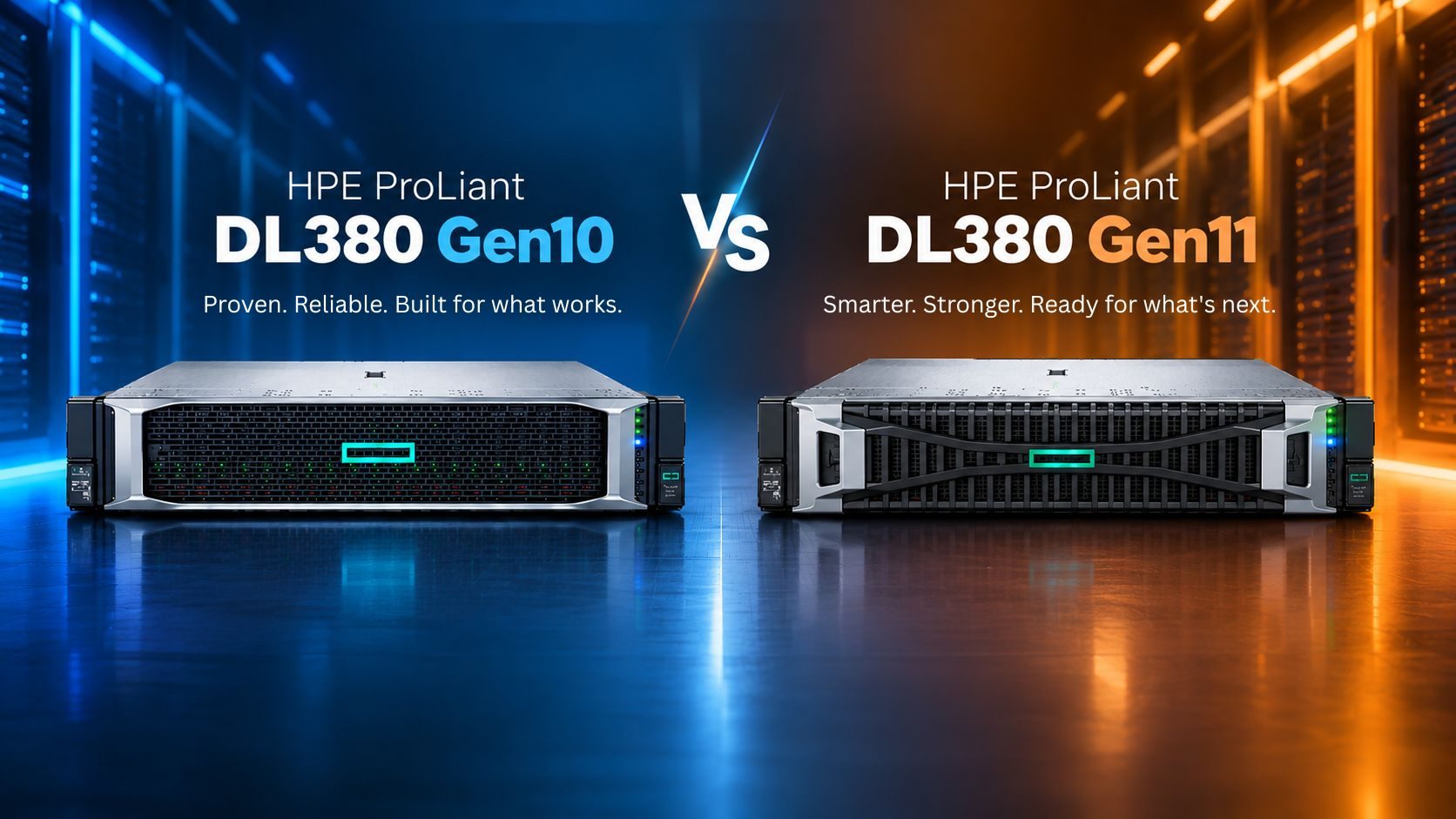
The 2U dual-socket rack server has long been the foundational workhorse of corporate datacenters, virtualization clusters, and private cloud deployments across the UAE. For nearly a decade, the HPE ProLiant DL380 has occupied the benchmark position in enterprise reliability and channel adoption.
With the maturity of the HPE ProLiant DL380 Gen11, IT Directors and Datacenter Architects in Dubai and Abu Dhabi face an important procurement question: When is upgrading from Gen10 or Gen10 Plus to Gen11 mandatory, and where can existing Gen10 infrastructure continue to serve reliably? This engineering evaluation provides a comprehensive architectural deep dive to inform your multi-year server roadmap.
Architectural Specifications: Gen10 vs Gen10 Plus vs Gen11
The table below contrasts the certified platform capabilities across generations of the ProLiant DL380 family.
| Architecture Element | HPE DL380 Gen10 / Gen10 Plus | HPE DL380 Gen11 (`P52560-B21`) |
|---|---|---|
| Processor Generation | Intel Xeon Scalable 1st/2nd Gen (Gen10) or 3rd Gen Ice Lake (Gen10 Plus) | Intel Xeon Scalable 4th/5th Gen (Sapphire / Emerald Rapids) |
| Maximum Core Count | Up to 28 cores (Gen10) / 40 cores per socket (Gen10 Plus) | Up to 64 cores per socket (128 cores total) |
| Workload Accelerators | Intel AVX-512, DL Boost | Intel AMX (Advanced Matrix Ext), QAT, IAA, DSA built-in |
| Memory Architecture | DDR4 SmartMemory up to 3200 MT/s, 8 channels/socket | DDR5 SmartMemory up to 4800 / 5600 MT/s, 8 channels/socket |
| Maximum Memory Capacity | Up to 6.0 TB (32x 256GB LRDIMM / Persistent Memory) | Up to 8.0 TB (32x 256GB DDR5 RDIMM) |
| PCIe Bus Specification | PCIe Gen3 (Gen10) / PCIe Gen4 (Gen10 Plus, 16 GT/s) | PCIe Gen5 (32 GT/s per lane, up to 8 slots) |
| Mezzanine Network Form Factor | FlexibleLOM (Gen10) or OCP 3.0 (Gen10 Plus) | Dual OCP 3.0 Mezzanine Slots standard |
| Storage Controller Subsystem | HPE Smart Array P408i-a / E208i-a (12Gbps SAS) | HPE MR416i-p / MR408i-o Tri-Mode (NVMe / SAS / SATA) |
| Internal Drive Backplanes | Up to 24+6 SFF SAS/SATA/NVMe or 12+4 LFF | Up to 24+8 SFF EDSFF E3.S / NVMe / SAS / SATA or 12 LFF |
| Remote Management & Security | HPE iLO 5 with Silicon Root of Trust | HPE iLO 6, Silicon Root of Trust, Compute Ops Management |
| Power Supply Efficiency | 500W, 800W, 1600W Platinum (Up to 94% efficiency) | 800W, 1000W, 1600W, 2200W Titanium (Up to 96% efficiency) |
Processor Compute & Hardware Acceleration
The transition to 4th and 5th Generation Intel Xeon Scalable processors represents a fundamental shift from pure frequency and core count increases toward dedicated on-die workload accelerators.
While Gen10 Plus topped out at 40 cores with the Xeon Platinum 8380, the DL380 Gen11 supports up to 64 cores per socket (such as the Xeon Platinum 8592+ or 8490H), allowing a single 2U chassis to deliver 128 physical cores and 256 execution threads.
Crucially for UAE enterprises deploying AI inference, localized data analytics, and encryption intensive workloads, Gen11 includes hardware-accelerated engines:
- Intel Advanced Matrix Extensions (AMX): Accelerates deep learning matrix multiplication on CPU without requiring external GPU cards.
- Intel QuickAssist Technology (QAT): Offloads cryptography and data compression, freeing CPU cores for application execution.
- Intel In-Memory Analytics Accelerator (IAA): Accelerates database queries for enterprise in-memory databases like SAP HANA and Microsoft SQL Server.
DDR5 Memory Bandwidth: The Key to Virtualization Density
In dense VMware vSphere, Nutanix AHV, and Microsoft Hyper-V environments, memory bandwidth frequently constrains VM consolidation before CPU capacity is reached.
The ProLiant DL380 Gen11 features DDR5 SmartMemory operating at up to 5600 MT/s, delivering greater than 75% higher memory throughput compared to DDR4-3200 in Gen10. With 16 DIMM channels per dual-socket platform and capacity reaching 8 TB ECC DDR5, infrastructure architects can run 2.5x more active virtual machines per rack unit without experiencing memory bus latency degradation.
PCIe Gen5 Bus & Tri-Mode Storage Revolution
PCIe Gen5 doubles the raw interconnect speed from 16 GT/s (Gen4) to 32 GT/s per lane. In a fully populated DL380 Gen11 system, up to 8 PCIe Gen5 slots offer unprecedented I/O throughput for high-speed clustering:
- High-Speed Interconnects: Dual 100GbE or 200GbE Mellanox/Broadcom OCP 3.0 NICs operate without PCIe lane saturation.
- Tri-Mode RAID Controllers: The HPE MR416i-p Gen11 controller supports SAS, SATA, and NVMe drives simultaneously through PCIe Gen5 host connectivity with 4 GB / 8 GB Flash-Backed Write Cache (FBWC).
- Direct NVMe Arrays: With support for enterprise EDSFF (E3.S) and U.3 NVMe drives, storage latency drops to microsecond tiers for transaction-heavy financial and database systems in DIFC and ADGM.
For comprehensive technical details on enterprise server platforms and connected storage arrays, visit our HPE Servers & Enterprise Storage Hub.
Silicon Root of Trust & HPE iLO 6 Security
Cyber threats targeting low-level server firmware have grown dramatically. HPE was the first server manufacturer to introduce Silicon Root of Trust, an immutable fingerprint burned directly into the custom iLO ASIC.
In the DL380 Gen11, HPE iLO 6 expands this security posture with:
- SPDM (Security Protocol and Data Model): Authenticates PCIe cards and peripheral components at boot to prevent hardware supply-chain tampering.
- Automated Firmware Recovery: If corrupt firmware is detected, the server autonomously restores to the last known authenticated baseline.
- HPE GreenLake for Compute Ops Management: Centralized, cloud-native lifecycle management allowing UAE IT teams to deploy, monitor, and update servers across distributed offices from a single pane of glass.
UAE Datacenter Upgrade Decision Matrix: When to Upgrade?
Not every server in your inventory requires immediate replacement. Use this practical framework developed by our senior systems engineers:
Retain or Expand Existing HPE DL380 Gen10 Infrastructure When:
- Running legacy operating systems (Windows Server 2016 or early Red Hat editions) that lack native drivers for Gen11 chipsets.
- Workloads consist of standard Active Directory, print serving, staging DNS, or low-utilization file repositories.
- The existing chassis is under active HPE Care Pack warranty and replacement components (DDR4 RAM, 12G SAS drives) are readily available.
Mandate Upgrades to HPE DL380 Gen11 Infrastructure When:
- Executing a datacenter consolidation initiative to reduce physical rack space, power consumption, and colocation costs in UAE hosting facilities (e.g., Equinix Dubai, Khazna).
- Deploying SAP HANA, large-scale Microsoft SQL clusters, or high-density VMware vSphere 8 clouds that require DDR5 memory throughput.
- Integrating high-speed 25GbE/100GbE network fabrics where PCIe Gen4 represents a demonstrable I/O bottleneck.
- Upgrading to meet stringent UAE regulatory standards (NESA, DESC) that necessitate hardware-level firmware attestation and zero-trust supply chain validation.
Custom CTO/BTO Staging at Impact Tech Bur Dubai
Procuring enterprise servers through standard channel distributors often involves 6 to 10 week factory lead times. Impact Tech maintains local inventory of base DL380 Gen11 chassis, verified Intel Xeon processors, genuine HPE SmartMemory DIMMs, MR-series RAID controllers, and enterprise drive carriers at Office 407, Al Zahraa Techno Centre, Bur Dubai.
Our certified hardware technicians perform Custom-to-Order (CTO) integration, firmware updates, and 24-hour burn-in testing locally. UAE System Integrators receive fully assembled, verified, and plug-and-play servers with guaranteed manufacturer warranties delivered directly to their project sites in Dubai, Abu Dhabi, or Sharjah within 48 to 72 hours.